
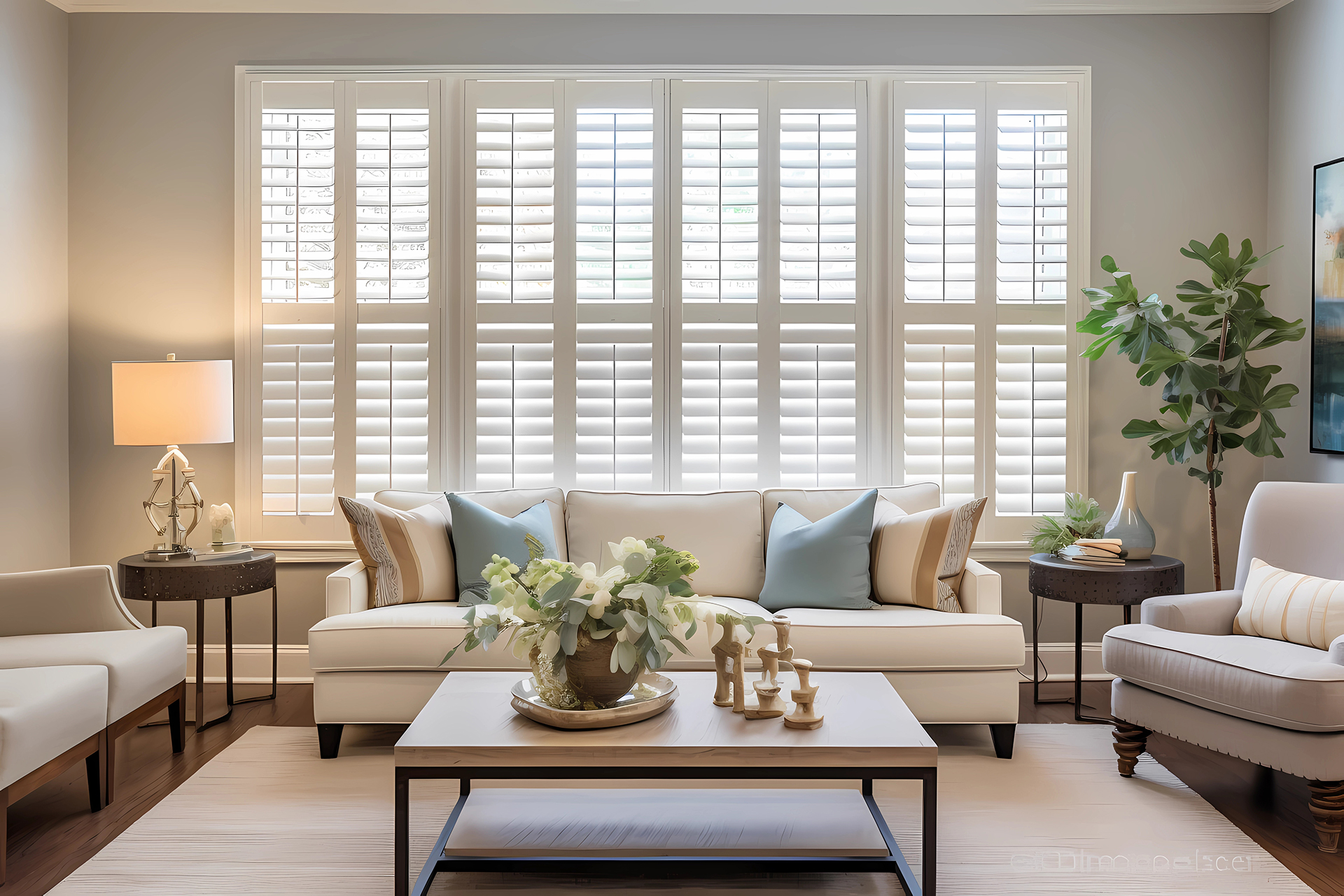
Living rooms need light, privacy, and steady comfort. Shutters do all three tilt to cut glare, close for privacy, and add a barrier at the glass. Windows drive 25–30% of home heating/cooling use, so the right shutter setup helps curb heat gain and loss.
If your TV catches afternoon glare or street-facing windows feel “on display,” shutters give fast control without killing daylight. They work as a daily tool, small tilt for screens and reading, full close at dusk and complement efficient windows or smart use. Energy programs also recognize window attachments (including shutters) for improving comfort and saving energy.
This guide shows the best living-room shutter ideas for 2025 and when to use each: wide-louver looks, café height for privacy with daylight, hidden-tilt for clean lines, split-tilt for street fronts, durable PVC for sun, and track systems for large doors so you can match style, view, and comfort goals room by room.
The quick guide to living room shutter blinds
- Measure width in three spots and height in two; order to the tightest for a snug inside mount and fewer light leaks.
- Pick louver size by room scale: 2½–3½” suits most spaces; 4½” feels modern, opens views, and reduces slat lines.
- Choose material for conditions: wood for warmth, composite/PVC for sun or humidity, aluminum/security for extra sturdiness.
- Decide tilt style early: center tilt is standard; hidden tilt may be available as a custom option confirmed at quote.
- (Optional/custom) Add a divider rail or split tilt on tall windows to keep lowers closed for privacy while uppers admit daylight confirmation at measure/quote.
- Match mount to casing: inside mount is tailored and minimalist; outside mount adds presence and covers imperfect trim.
- Color matters: match trim for a built-in look or go tone-on-tone with wall color to visually enlarge the room.
- Plan function: pair with drapery for softness and blackout, add light-blocking strips on edges, and consider motorized drapery tracks or roller shades for hard-to-reach windows.
Top 10 shutter for living room for 2025
Choose louver width for view, tilt style for look, material for conditions, and mount for light control then finish with color to nail the living-room vibe.
|
Comparison table for 10 best living room shutter ideas
Choosing the best living room shutters depends on your style, privacy needs, and budget. Below, we explore each type from modern plantation shutters to energy-efficient PVC shutters so you can find the perfect fit.
| Idea | Best For | Key Benefits | Light & Privacy Control | Notes / When to Choose | ||
| Modern Wide-Louver Living Room Shutters | Bigger rooms, open sightlines | Fewer slat lines, contemporary look | Wide tilt = bright views; close for strong privacy | Choose 3½–4½″ louvers for a modern vibe and easier cleaning | ||
| French Door Shutters with Handle Cutouts | Patio/French doors with knobs or levers | Clean swing, built-in look, no hardware clash | Tilt for glare control; close tight for privacy | Choose when doors need full use without removing panels | ||
| Wood Plantation Shutters | Formal living rooms, warm finishes | Natural grain, rich paints/stains | Precise louver tuning; excellent room darkening when closed | Best for stable humidity; premium feel and resale appeal | ||
|
Out-of-square trim, shallow depths, light gaps | Covers flaws, tighter edges, crisper lines | Wider frame reduces edge glow; better darkening | Use when inside mount won’t seal or windows are uneven | ||
| Color-Matched Custom Paint/Stain Shutters | Cohesive living rooms, design accents | Factory finish matches trim or contrasts | Same precise tilt; darker tones can reduce perceived glare | Pick to blend with casing or create a subtle feature wall | ||
| Composite/PVC Interior Shutters | Sun-heavy or kid-/pet-active spaces | Durable, wipe-clean, warp-resistant | Consistent light control; resists discoloration | Smart choice for long sun exposure or everyday wear | ||
| Sliding/Bifold Shutters for Patio Doors | Wide sliders, indoor-outdoor flow | Tracks glide smoothly; space-saving | Panel stacking opens full daylight; closed = privacy | Matches living rooms that open to patios/decks | ||
| Custom Bay & Bow Living Room Shutters | Angled/faceted windows | Tailored fit, built-in appearance | Independent panels for nuanced light | Keeps symmetry across complex window geometries | ||
| Arched & Specialty-Shape Living Room Shutters | Arches, circles, eyebrows | Maintains design continuity | Custom louvers manage light on irregular shapes | See real installs in the Project Gallery | ||
| Interior Aluminum / Security-Rated Looks | Street-facing fronts, large spans | Added sturdiness, sleek profiles | Strong privacy and light block when closed | Consider where extra robustness and clean lines matter |
#1. Modern Wide Louver Living Room Shutters
Wide 3½–4½″ louvers deliver a crisp, contemporary look that visually “opens” the living room and reduces busy slat lines. They tilt quickly to cut TV glare and street views without sacrificing the bright, airy feel people want in social spaces.
Because each louver spans more glass, you get broader sightlines when open and stronger privacy when closed ideal for picture windows and wide spans. The result is cleaner design, faster light control, and a living room that stays comfortable from noon sun to movie night.
Wide louvers streamline the view, tame glare with small tilt moves, and close tight to help reduce drafts and radiant heat off the glass.
Best Rooms & Orientations
Rooms: open-plan living rooms, great rooms
Windows: any; especially large or picture windows
How this Improves Comfort & Energy
- Larger louver area is equal to brighter views at partial open settings and less eye strain.
- Quick tilt cuts mid day glare without darkening the whole room.
- Closed panels add a modest thermal and draft barrier at the window.
Pro Install Tips
- Confirm hinge count and stile reinforcement on wide/tall panels for rigidity.
- Consider hidden tilt for maximum light and the cleanest sightlines.
- Match frame profile to wall conditions to keep panels square and gap free.
#2. Café-Style (Half-Height) Living Room Shutters
Café-height panels cover the lower sash for privacy while the top glass stays open to daylight and sky. Perfect when your living room faces the street but you still want a bright, welcoming feel.
By blocking sightlines at sofa level, you cut TV glare and prying eyes while keeping the room light and cheerful.
This balanced look stays airy by day and pairs easily with drapery at night.
Best Rooms & Orientations
- Rooms: Street-facing living rooms, bays, front parlors
- Windows: First-floor fronts, tall double-hung windows
How this Improves Comfort & Energy
- Shields lower glass from low-angle sun and passersby while preserving daylight.
- Reduces glare right at seating height for easier TV time.
- Closes quickly at dusk without darkening the whole room.
Pro Install Tips
- Align the top rail with existing mullions for a tailored line.
- Consider hidden tilt for a cleaner view through the upper glass.
- Layer with drapery/valance for nighttime darkening and extra insulation.
#3. Wood Plantation Shutters
Wood brings a furniture grade finish painted or stained that feels built in and elevates traditional or transitional living rooms. Its natural rigidity keeps louvers aligned for precise light control and long term durability when properly finished.
The warmth of grain and crisp joinery pairs beautifully with trim, giving a custom, upscale presence without visual heaviness. Wood also adds a touch of mass at the window, helping buffer drafts and temperature swings.
Wood shutters deliver refined style, exact louver tuning and a premium finish that complements classic casing while improving comfort
Best Rooms & Orientations
Rooms: formal living rooms, libraries, dens
Windows: stable humidity exposures; avoid heavy steam
How this Improves Comfort & Energy
- Close packed louvers reduce drafts and radiant heat at the glass.
- Wood’s mass helps calm temperature swings for steadier comfort.
- Tight closure aids TV glare control without relying on heavy drapery.
Pro Install Tips
- Seal and finish all sides to protect against warping and sunlight.
- Specify a divider rail on tall windows for independent top/bottom control.
- Match paint sheen and profile to existing trim for a true built in look.
#4. Hidden-Tilt Contemporary Living Room Shutters
Hidden tilt removes the center rod for cleaner sightlines and more visible glass. You get the same precise louver control with a sleeker, modern profile.
This detail works especially well on picture windows and wide spans where every bit of view matters. Fine tilt adjustments tame daytime glare while keeping rooms bright.
Best Rooms & Orientations
Rooms: Contemporary or minimalist living rooms
Windows: Picture windows, wide banks, symmetrical pairs
How this Improves Comfort & Energy
- More visible glass at partial-open settings = brighter rooms with less eye strain.
- Quick micro-tilts cut glare without pulling the room dark.
- Closed panels add a modest barrier to drafts and radiant heat.
Pro Install Tips
- Confirm louver synchronization across multi-panel runs.
- Use low-profile frames and color-matched hinges for a seamless look.
- Add a mid-rail for rigidity on tall panels or high-traffic areas.
5. Divider-Rail / Split-Tilt Living Room Shutters
A divider rail or split-tilt lets top and bottom sections move independently—privacy below, soft daylight above.
Ideal for street-facing rooms where you want light without feeling “on display.” Everyday use is simple: keep lowers closed at sofa height, crack uppers for glare-free light.
Best Rooms & Orientations
Rooms: Living rooms facing sidewalks/traffic, bay windows
Windows: Tall double-hung or multi-panel assemblies
How this Improves Comfort & Energy
- Blocks low-angle sun where heat and glare hit most.
- Preserves daylight up high to reduce lamp use.
- Helps steady temps at seating level when lowers are closed.
Pro Install Tips
- Set rail height near eye level or align with existing mullions for clean lines.
- Verify handle/lock clearances and panel swing around furniture.
- Pair with drapery for evening blackout and extra insulation.
#6. Composite/PVC Interior Shutters
Composite & PVC shutters give you the crisp, painted wood look with extra durability for sunny living rooms and busy households. They resist warping and discoloration, so your panels stay straight and smooth even on west and south facing walls.
The wipe clean finish makes upkeep simple, while sturdy stiles and rails keep louvers aligned for precise light and privacy control day after day. It’s a practical, polished choice when you want long lived performance without high maintenance care.
Composite & PVC shutters deliver wood like style with warp resistance, easy cleaning and reliable light control in high sun living rooms.
Best Rooms & Orientations
Rooms: active family living rooms, media spaces
Windows: strong west & south exposures and large spans
How this Improves Comfort & Energy
- Tight louver closure helps cut glare and radiant heat at peak sun.
- Material stability maintains a consistent seal over time.
- Reduces reliance on AC during late afternoon heat spikes.
Pro Install Tips
- Specify UV stable finishes; consider reinforced stiles on wide panels.
- Confirm hinge grade for heavier composite panels.
- Use light blocking strips on edges if you need a near blackout.
#7. Sliding/Bifold Shutters for Patio Doors
Track mounted shutter panels glide across big sliders so your living room and patio feel connected without sacrificing privacy. Open the stack to flood the room with daylight; close it at dusk to control light and views.
Because panels travel on tracks, they handle wide openings smoothly and store neatly, keeping furniture clear and pathways open. The result is indoor outdoor flexibility with the same louver precision you expect on windows.
Sliding & bifold shutters tame wide door glare, boost privacy at night and keep traffic flow effortless in living rooms that open to patios.
Best Rooms & Orientations
Rooms: living rooms with decks/patios
Openings: large sliders and multi panel glass doors
How this Improves Comfort & Energy
- Blocks late day heat on big glass to ease AC load.
- Lets you micro tune louvers for TV time without fully closing.
- Creates an insulating layer at night over expansive doors.
Pro Install Tips
- Plan panel stack direction away from primary walkways.
- Choose low profile tracks and confirm floor guide clearance.
- Add handle cutouts and door clearance checks during measure.
#8. Custom Bay & Bow Living Room Shutters
Bays and bows deserve a tailored fit faceted frame hug each angle so the whole window reads as built in and cohesive. Individual panels on each facet let you tune light and privacy per section without flattening the bay’s dimensional character.
This approach controls glare hotspots common in bays while keeping the nook bright and usable throughout the day. You maintain symmetry from outside and gain flexible control inside for reading, TV or gatherings.
Custom bay/bow shutters provide a tailored, built in look while dialing down glare on each facet for comfortable all day use.
Best Rooms & Orientations
Rooms: living rooms with projecting bays/bows
Windows: multi facet or angled assemblies
How this Improves Comfort & Energy
- Targets solar hotspots on specific facets without darkening the whole bay.
- Helps reduce drafts where trim transitions meet.
- Supports steady temperatures in a typically leaky window type.
Pro Install Tips
- Template every facet; align rail heights across faces for visual continuity.
- Use frames designed for angles; confirm sill and head returns match.
- Consider a split tilt or divider rail strategy on tall facets.
#9. Arched & Specialty Shape Shutters
Architectural windows, arches, circles, rake tops deserve custom shaped shutters that keep the feature visible while delivering real light and privacy control. Precision templating matches the curve or angle so the finished look feels intentional and built in.
With operable lowers and fixed/operable tops (depending on shape), you maintain symmetry from the street and gain everyday usability inside. The result is the statement windows that finally work as well as they look.
Specialty-shape shutters preserve the windows character while cutting glare at the arc and sealing tricky edges for better comfort.
Best Rooms & Orientations
Rooms: living rooms with focal windows or high transoms
Windows: arches, eyebrows, circles and rake & triangle tops
How this Improves Comfort & Energy
- Tames top arc hotspots and softens harsh daylight.
- Completes the thermal “frame” where curtains often leak light.
- Adds privacy without draping over the windows unique shape.
Pro Install Tips
- Provide precise templates; confirm radius and reveal depth before fabrication.
- Consider fixed tops with operable lowers for tall arches.
- Align rail heights with nearby rectangular windows for cohesion.
#10. Interior Aluminum / Security-Rated Looks
Finish drives the vibe like matching the trim gives a seamless, built in feel that visually enlarges the room, while a contrast color turns the shutters into a subtle feature wall. Both options retain quick, precise control over daylight and privacy.
Color strategy also affects perception; lighter tones brighten and blend, deeper hues minimize glare lines and add graphic punch. Either way, you get durable, wipe clean panels that perform daily and photograph beautifully.
Color matched shutters disappear into the architecture; contrast tones make a design moment without losing function or comfort.
Best Rooms & Orientations
Rooms: any living room; especially neutral spaces or symmetrical window walls
Windows: focal walls, fireplace flanks or paired picture windows
How this Improves Comfort & Energy
- Same light/draft control as standard finishes; darker colors can reduce perceived glare.
- Encourages partial open use (better daylight) because the look stays tidy.
- Supports steady evening temps when fully closed.
Pro Install Tips
- Sample swatches in morning, noon & evening light; confirm sheen to match casing.
- Request UV stable paints/stains; specify color matched hinges and low profile frames.
- For contrast looks, echo the shutter color in pillows & art for balance.
Which Shutter Fits Your Window
- If your living room faces the street, pick cafe height or split tilt so the lower louvers stay closed for privacy while the top brings in daylight.
- For a bright, modern look with fewer slat lines, choose wide louvers (3½–4½”); they open views when tilted and still shut tight at night.
- Choose wood for a premium, furniture grade finish in stable conditions; choose composite & PVC if you need easy care durability and moisture resistance
- If your window is out of square or you see light gaps, go outside mount (a framed box) to cover imperfections and tighten the seal.
- On big sliders or wide openings, use sliding/bifold tracks so panels glide aside for daytime views and close at dusk for privacy and glare control.
- Prioritize comfort: windows drive roughly 25–30% of heating/cooling energy. Using energy-efficient shutters at peak sun or overnight helps steady room temps while keeping your living room design modern and functional.
- Budget realistically: typical installed costs cluster around $20–$45 per sq ft (varies by material, size, and finish).
FAQs
1) Do living room shutters actually help with energy bills?
Yes, DOE notes windows account for about 25–30% of home heating/cooling energy use, so using window coverings strategically (closed at peak sun or overnight) can reduce heat gain & loss and improve comfort.
2) Which louver size is best for living rooms?
Most homeowners pick 3½” for balance; 4½” feels modern and opens views with fewer slat lines, while 2½” looks traditional but shows more lines. Availability commonly spans 2.5″, 3.5″, and 4.5″.
3) Wood vs. composite: which lasts longer in sunny rooms?
Composite & faux wood resists moisture and warping and is a safe bet for sun or mixed conditions; wood offers richer finishes but needs careful finishing and stable humidity.
4) Are café style shutters good for street facing living rooms?
Yes, café shutters cover the lower half for privacy while keeping the top open for daylight, an approach born in European cafés and still great for first floor living rooms.
5) Will shutters reduce TV glare in my living room?
Yes, tilting louvers lets you cut low angle sun without darkening the room; wider louvers need smaller adjustments to tame glare across big panes.
6) What do shutters typically cost in 2025?
Expect ~$20–$45 per sq ft installed, with material, custom colors and specialty shapes pushing higher; per-window averages often land in the $70–$350 range.
7) Do shutters replace curtains, or should I layer both?
Shutters handle daily light/privacy; many homeowners layer drapery for softness and extra blackout/insulation at night, especially on street-facing fronts. (Layering is a design choice; performance benefits vary by fabric and usage.)